


June 1, 2026

How to Reduce Roofing Material Waste: Calculate the Right Amount Every Time

Author

Liam Walsh

9 minute read

Share

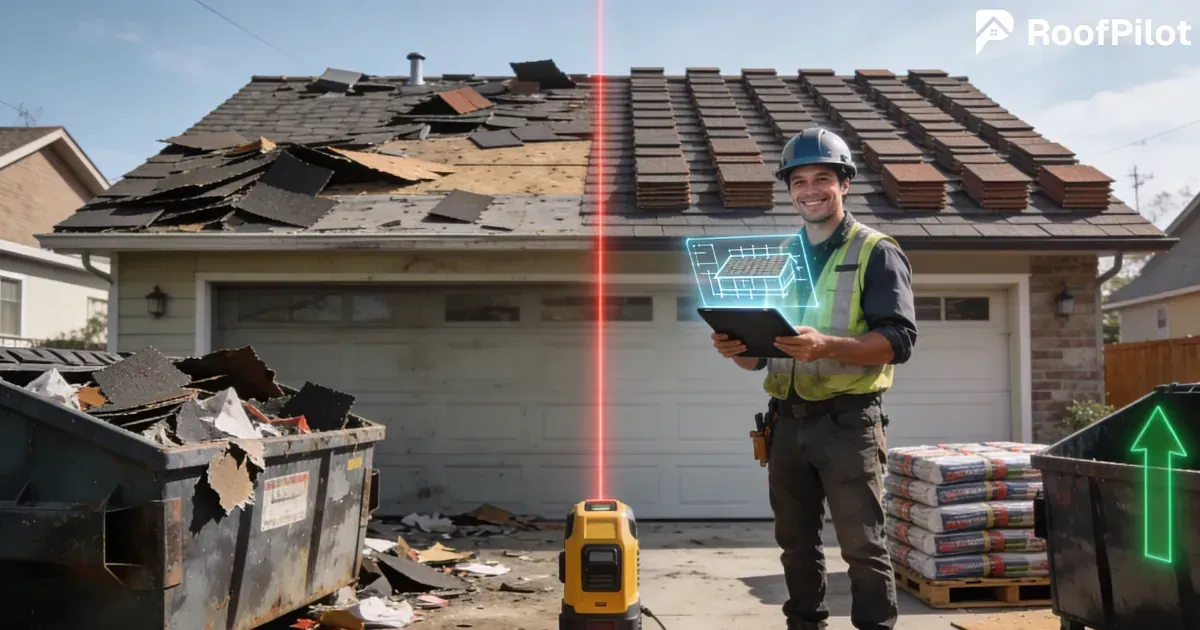
Roofer using roof waste calculator on tablet to accurately measure materials and reduce waste compared to traditional methods

Material waste is one of the most consistent hidden profit killers in roofing. On a 25-square job, a waste rate of 18% means 4.5 squares of shingles going into a dumpster instead of generating margin. At 2026 material prices — elevated by years of supply chain disruption and ongoing tariff pressures on imported construction goods — that's $600 to $1,500 walking off every single job. Multiply that across 150 or 200 jobs a year and you're looking at a six-figure number. According to the EPA's Sustainable Materials Management program, construction and demolition material waste is one of the largest waste streams in the U.S. economy — and over-ordering is a significant contributor.


The good news is that material waste is largely a measurement and calculation problem, not a crew problem. With accurate roof measurements, correctly applied waste factors, and disciplined ordering practices, most roofing companies can reduce waste significantly without changing how jobs are installed.

What Waste Is Actually Costing You

Expensive roofing material waste going into dumpster with lost money, highlighting the high cost of inaccurate roof waste calculations

Consider a roofing company doing 200 jobs per year, average job size 25 squares, material cost of $150 per square. At an 18% waste rate, that company orders 5,000 squares annually and wastes 900 of them — $135,000 in materials that never generate revenue.


Bring that waste rate down to 10% — a realistic target with accurate measurements and proper waste factor calculations — and waste drops to 500 squares, costing $75,000. That's $60,000 recaptured annually without changing a single job, hiring anyone, or adding revenue. It's pure margin recovery, and it's available to any roofing company willing to tighten up how they measure and order.


What this means for your business: Waste reduction isn't a side project — it's a direct profit improvement. Every roofer who's still eyeballing quantities or defaulting to a 20% buffer on every job is effectively writing a check to the dumpster on each job they close.

What Causes Over-Ordering

Understanding why waste happens is the first step to fixing it.


The most common cause is inaccurate roof area. Specifically: using the building footprint instead of the actual roof surface area. A 2,000 sq ft footprint at 6/12 pitch is actually 2,236 sq ft of roof — a 12% difference that immediately throws off every downstream calculation. Apply the wrong starting number and no waste factor will correct the error. For a complete breakdown of how to calculate true roof area by pitch, see the guide to how to calculate roof size.


The second cause is applying a generic waste factor regardless of roof type. A single 10% buffer applied to every roof over-orders on simple gables and under-orders on complex hips with dormers and valleys. Treating every roof the same isn't conservative estimating — it's imprecise estimating, and it produces inconsistent results in both directions.


The third cause is the "just in case" mindset — intentionally ordering extra material because running short mid-job is expensive and inconvenient. This thinking isn't wrong in principle, but it typically goes too far. The right contingency built into a calculated waste factor is different from reflexively adding two extra squares to every order.


Finally, materials come in fixed packaging. You can't order exactly 23.7 squares — you order 24. Shingles come in bundles (three per square typically, though this varies by manufacturer), underlayment in rolls covering specific square footage, flashing in linear foot quantities. These rounding effects are small per job but add up across a year's volume.


Waste Factors by Roof Type

Waste factors by roof type showing 8 percent on simple roof, 13 percent on medium, and 18 percent on complex roof with multiple hips and valleys

The right waste factor depends on roof complexity. Using a complexity-matched factor rather than a universal one is the single most direct way to reduce waste without changing anything about how jobs are installed.

Roof Type Recommended Waste Factor
Simple gable (minimal penetrations) 7–8%
Standard hip roof 12–13%
Moderate complexity (valleys, dormers) 15–17%
High complexity (multiple sections, skylights) 18–20%
Extreme complexity 20–22%

Simple gable roofs have low waste because shingles install in straight rows with cuts only at rake edges and around vents. Hip roofs generate more waste at the angled hip lines and require more hip and ridge cap material. Complex roofs with multiple valleys and dormers create waste at every intersection and penetration, and irregular section geometry means more partial cuts.


Adjust upward from the base factor for roofs above 9/12 pitch (add 2–3% for steepness), for materials with higher installation waste characteristics like tile or wood shakes (add 3–5%), and for new crew members working an unfamiliar material type (add 2–3% until production data gives you a better baseline).


How to Calculate Accurate Material Quantities

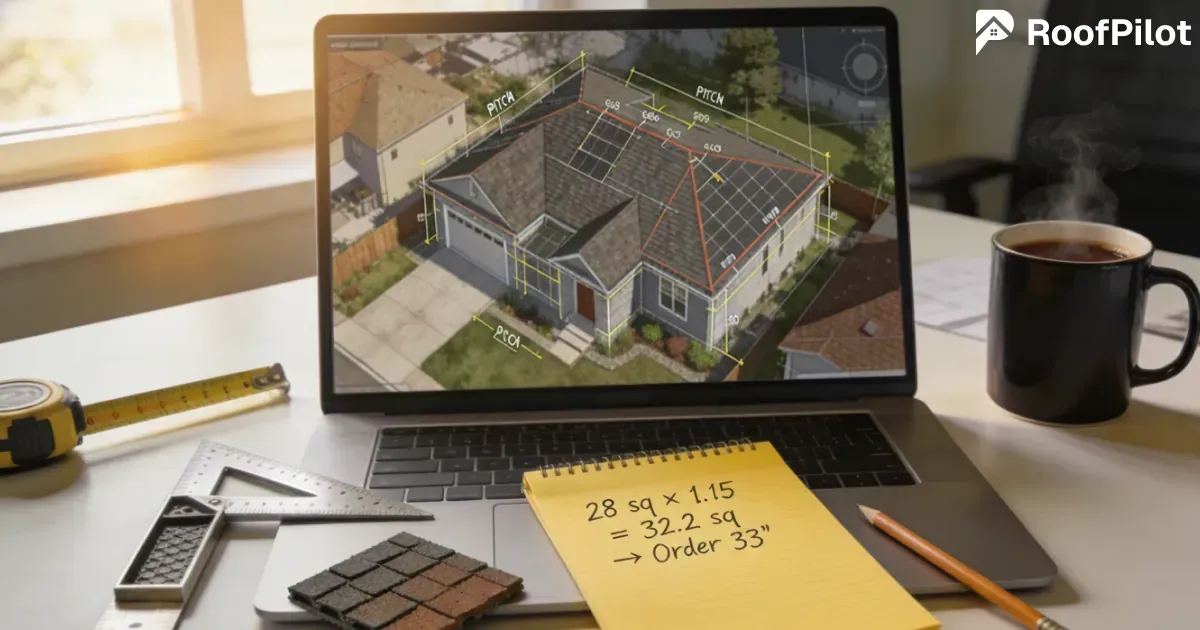
Accurate roofing material quantities calculated on laptop with 3D model showing proper waste factor and ordering recommendation

Step 1 — Get verified roof measurements. Start with actual surface area, not building footprint. This means using aerial roof measurement tools or manual on-roof measurement — never footprint-plus-estimate. You need total roof area adjusted for pitch, area by section if different pitches are present, and all linear measurements: ridge, hip, valley, eave, and rake lengths. The linear measurements are what drive hip and ridge cap, starter strip, drip edge, and ice-and-water shield quantities — and they're often the most overlooked part of a material order.


Step 2 — Select the appropriate waste factor. Match the factor to the actual roof complexity using the table above. Don't adjust up just because the customer is particular or the job is important — the factor should reflect the geometry of the roof, not anxiety about running short.


Step 3 — Calculate total primary material. Apply the formula: Total Material = Roof Area × (1 + Waste Factor). A 25-square roof at 15% waste needs 28.75 squares — order 29. A 25-square roof at 8% waste needs 27 squares — order 27. The difference between these two numbers on a typical job is 1–2 squares, which at current pricing is $150–$300. Across a year's volume, that difference is significant.


Step 4 — Calculate accessories from linear measurements. Underlayment coverage varies by product (check manufacturer specs — synthetic rolls often cover significantly more than felt). Hip and ridge cap is calculated in linear feet of ridges and hips, with coverage per bundle varying by product (typically 20–35 linear feet). Starter strips, drip edge, and ice-and-water shield are all linear foot calculations from your measurement report. Don't estimate these from area — use the linear measurements you already have.


Step 5 — Review before ordering. Confirm material specifications match what was quoted to the customer, check supplier inventory and lead times, and verify that the order quantities make sense for the roof. A sanity check against the actual measurement report takes five minutes and catches the errors that create mid-job supply runs.

Field Practices That Reduce Waste

Accurate ordering gets you most of the way there. Job site practices determine the rest.


Material storage affects waste more than most roofers account for. Shingles stored incorrectly — stacked too high, exposed to moisture, or left on uneven ground — can warp or delaminate before they're ever installed. Store shingles flat on pallets, keep them covered but ventilated, and limit stacking height. Underlayment should be stored upright and kept dry. These aren't labor-intensive steps — they're habits that prevent wasted materials that were ordered correctly but damaged before use.


Crew installation practices also influence waste. Planning the starting point of each course to minimize partial shingles at the opposite rake, using cut pieces where geometry allows, and keeping unused materials organized between days all reduce waste at the margins. Training crews to track their material usage against the job estimate — how many bundles used vs. how many were delivered — creates accountability and generates the actual job data you need to refine future estimates.


For leftover materials, have a plan before the job closes. Unopened bundles can often be returned to the supplier, though policies vary. Surplus material suitable for warranty repairs can be stored on-site or at your shop for that customer. Documenting what's returned or retained is worth the few minutes it takes — it informs whether your waste factors are calibrated correctly.

Technology That Closes the Gap

The largest single driver of material waste is measurement error — starting with a wrong number and having every downstream calculation inherit that error. Modern RoofPilot-integrated aerial measurement removes this root cause by delivering accurate, pitch-adjusted surface area and complete linear measurements before a single bundle is ordered.


When measurements feed directly into material order quantities — without manual re-entry between a measurement report and an order form — the opportunity for transcription errors also disappears. Direct material ordering connected to verified measurements means the quantities on the truck match what was calculated from the actual roof, not from a re-typed number.


What this means for your business: If you're currently estimating materials from ground-based footprint estimates and adding a buffer, you're running a consistent measurement error into every order. Better tools don't just make the process faster — they change the accuracy of the starting number, which improves every downstream outcome.

A Real-World Example

A 2,800 sq ft roof (actual surface area) with a mixed profile — main gable with a hip section and one dormer, 8/12 pitch throughout, standard asphalt shingles.


Using a rough estimate: the roofer eyeballs 2,600 sq ft, rounds to 26 squares, adds 20% "just in case," and orders 32 squares. Actual usage: 29 squares. Waste: 3 squares — roughly $450 in materials.

Using accurate measurement and calculated waste: aerial measurement confirms 2,800 sq ft = 28 squares. The roofer applies 13% waste (appropriate for this mixed-complexity roof): 31.6 squares, rounded to 32. Actual usage: 30 squares. Waste: 2 squares — roughly $300 in materials.


The total order is the same, but the second approach arrives at that order through verified measurement and a deliberate waste factor rather than a rough estimate plus anxiety buffer. More importantly, when the roofer's measurement improves with better tooling, that 2,800 sq ft number is accurate — not a guess that happened to be close. The improvement compounds over a year's volume.

The Bottom Line

Every square of wasted material is margin that never shows up on your bottom line. For most roofing companies, reducing waste from 18% to 10–12% is achievable through two changes: getting accurate measurements instead of estimating from footprint, and applying complexity-matched waste factors instead of a universal buffer.


The math is straightforward. The tools exist. The roofers who tighten this up are not just ordering more precisely — they're protecting thousands of dollars per year in margin that's currently going into dumpsters.


Happy roofer holding tablet displaying financial dashboard
By Liam Walsh July 17, 2026
How to track roofing job costs, calculate true profit margins, and use the data to improve estimates — a practical job costing guide for roofers.

Roofer holding tablet showing job completed workflow with final payment still missing
By Liam Walsh July 13, 2026
How to get paid faster on every roofing job — deposit structures, payment terms, and invoicing tools that cut days-to-payment and protect cash flow.

Homeowner signing roofing contract on phone with verified digital signature
By Liam Walsh July 10, 2026
How to implement digital signatures for roofing contracts — legal validity, setup options, best practices, and how e-signatures close deals faster.

Roofer reviewing detailed roofing contract agreement with couple at kitchen table
By Liam Walsh July 6, 2026
What every roofing contract needs to protect your business — scope, payment terms, warranty language, change orders, and the clauses that prevent disputes.

Roofer presenting professional multi-option roofing proposal example on large tablet to homeowners
By Liam Walsh July 3, 2026
Roofing proposal examples for residential, storm damage, multi-option, and commercial jobs — with templates and the structure that turns estimates into signed contracts.

Roofer presenting professional digital roofing proposal on tablet to smiling homeowners
By Liam Walsh June 29, 2026
How roofing proposal software helps you quote faster, present professionally, and close more jobs — what to look for and how to get the most out of it.

Roofer doing door to door roofing sales showing tablet proposal to smiling homeowner at front door
By Liam Walsh June 26, 2026
How to run door-to-door roofing sales that actually work — territory strategy, opening scripts, objection handling, and the CRM setup that ensures no lead gets dropped.

Roofer in truck using roofing lead follow-up system on tablet
By Liam Walsh June 22, 2026
The roofing lead follow-up sequence that converts more estimates — timing, scripts, and templates for phone, text, email, and the CRM setup that makes it automatic.

Roofer reviewing roofing marketing dashboard with closed jobs, revenue, and cost per lead
By Liam Walsh June 19, 2026
How to track roofing lead sources and calculate true marketing ROI — from setup to monthly review — invest in what actually closes jobs, not just generates leads.

Roofer closing more roofing jobs by presenting clear proposal on tablet to smiling homeowner
By Liam Walsh June 15, 2026
How to close more roofing jobs without adding headcount — speed, professional proposals, a repeatable sales process, and the follow-up system that converts.