July 3, 2026

Roofing Proposal Examples That Win Jobs

Author

Liam Walsh

9 minute read

Share

Roofer presenting professional multi-option roofing proposal example on large tablet to homeowners with material specs, warranties, payment details, and e-signature ready

Most homeowners requesting roofing quotes will receive multiple estimates. What separates the roofer who wins from the ones who don't often isn't price — it's the quality of the proposal. A homeowner who receives one polished, photo-documented, digitally signable proposal alongside two handwritten sheets will default toward the one that felt professional, even if the price is comparable. As SCORE notes in its business development resources, a proposal is rarely just a price quote — it's the first demonstration of how you work.


This guide breaks down five proposal types that roofing companies use to win jobs, with template structures you can adapt for your business. For guidance on the software that makes producing them fast, see the guide on roofing proposal software.


What Every Roofing Proposal Needs

Before the specific formats, a few elements belong in every roofing proposal regardless of job type. These aren't formalities — each one directly affects whether the homeowner trusts you enough to sign.


Your company branding should carry through the entire document: logo, colors, contact information. A well-branded proposal communicates permanence and professionalism before the homeowner reads a single line. Customer name, property address, proposal date, and validity period establish this document as specific to them, not a generic template they're reading alongside five others.

The scope of work is where proposals win or lose. Specific material names — brand, model, grade, warranty tier — tell homeowners what they're paying for and signal that you know your trade. What's not included matters as much as what is: clearly stating that decking repair is billed separately if discovered during tear-off eliminates a common dispute trigger before the job starts.

Warranty language should cover both the manufacturer warranty and your workmanship warranty separately, with clear terms. Homeowners making a $10,000–$20,000+ decision place significant weight on how warranty coverage is explained. And the acceptance section — signature lines, deposit terms, and a clear path to moving forward — should make saying yes as easy as possible.


Example 1: The Standard Residential Proposal

This is the workhorse format for straightforward residential replacements — standard shingle jobs where the scope is defined and the customer wants to understand what they're getting and move forward.


The key to this format is specificity in the materials section. Rather than "architectural shingles," write "Owens Corning Duration architectural shingles, Lifetime limited warranty, color: Estate Gray." Rather than "underlayment," write "synthetic underlayment." Every named material is a commitment that builds trust and differentiates you from the roofer who left a one-page quote with no product details.


Template structure:

[COMPANY LOGO]

ROOFING PROPOSAL

Prepared for: [Customer Name] · Property: [Address] · Date: [Date] · Valid: 30 days


SCOPE OF WORK

Removal: Remove existing asphalt shingles (one layer). Inspect decking for damage.

Installation: Install [Brand] synthetic underlayment. Install ice and water shield at eaves (36") and valleys. Install [Brand/Model] architectural shingles, color: [Color]. Replace all pipe boots and vent covers. Install new aluminum drip edge. Install hip and ridge cap shingles. Complete cleanup including magnetic nail sweep.


Not included: Decking repair (billed by change order if discovered). Gutter work. Interior repairs.


YOUR INVESTMENT

Description Amount
Complete roof replacement as described $XX,XXX

Payment terms: 50% deposit on signing · 50% on completion


TIMELINE

Anticipated start: Within 14 days of signed contract. Estimated duration: 1–2 days.


WARRANTY

Manufacturer: [Brand] Lifetime Limited Warranty on shingles. Workmanship: 5-year warranty on installation from [Company Name].


ABOUT [COMPANY NAME]

[2–3 sentences: years in business, licenses, insurance, certifications.]

Licensed · Bonded · Insured · License #[Number]


ACCEPTANCE

By signing below, I agree to the scope and terms described in this proposal.

Customer Signature: _________________ Date: _______


Why this format works: the homeowner sees exactly what they're getting, who they're hiring, and what happens next. There are no surprises embedded in vague language that could become disputes later.

Example 2: The Storm Damage and Insurance Proposal

Roofer presenting detailed roofing bid template and proposal example on tablet with aerial photos and specifications to homeowners in kitchen

Insurance claims require a different framing. The homeowner's primary concern isn't the total job cost — it's their out-of-pocket deductible. The proposal structure should make that number prominent and explain exactly how the insurance process works.


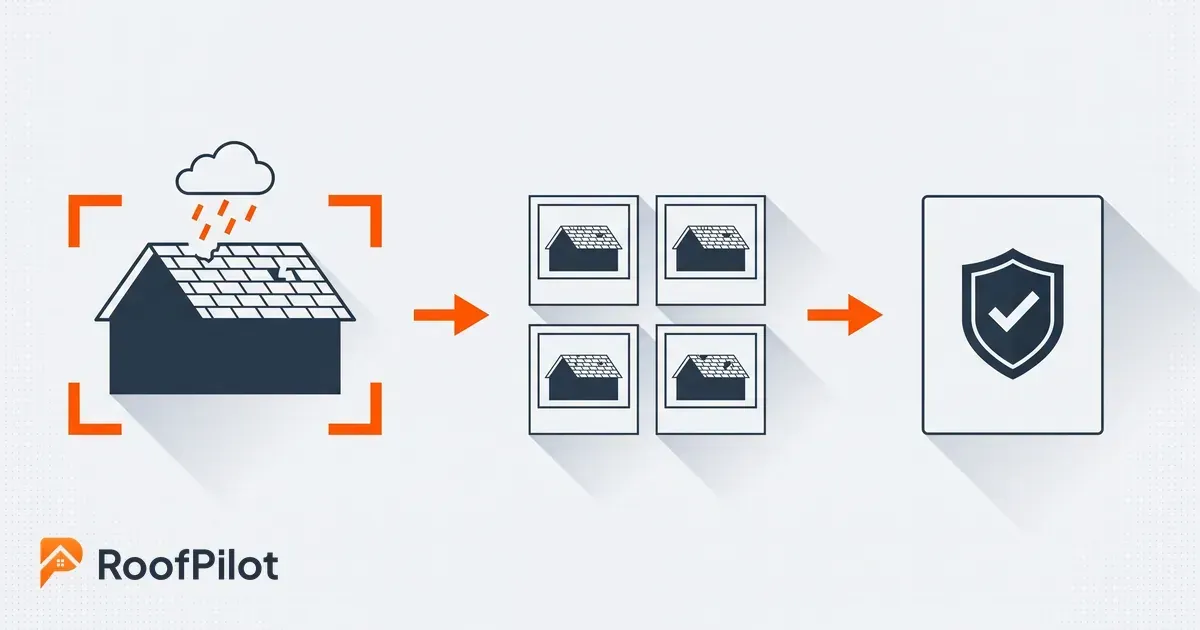
This format also needs damage documentation front and center. Roof measurement tools and inspection photos give you the materials to document damage systematically. A homeowner who sees photos of their own damage in the proposal understands immediately why the work is necessary — you've done the inspection, you've documented it, and you're presenting the evidence rather than asking them to take your word for it.


Template structure additions for insurance jobs:

Include a damage assessment section before the scope of work, with numbered damage items and attached photos. Add an insurance process section that explains: what the homeowner's deductible covers, how insurance payments work, and that you handle communication with the adjuster if supplemental claims are needed.


The pricing section should show the full replacement value, the insurance coverage amount, and the customer's share (deductible) clearly separated. "Amount due from customer: $[Deductible]" is the number they've been worried about, and making it the headline of the pricing section reduces friction considerably.


Example 3: The Good-Better-Best Multi-Option Proposal

Female roofer showing good-better-best roofing proposal example with Essential, Professional, and Premium pricing options on tablet to smiling couple

Multi-option proposals consistently produce higher average job values and higher close rates than single-price proposals. The psychological reason is straightforward: when a homeowner has three options, they're choosing between your tiers rather than deciding whether to hire you at all. The decision shifts from "yes or no" to "which one."


Structure three clearly differentiated options — Essential, Professional, and Premium work well as tier names. Each should include different material grades (3-tab vs. architectural vs. designer shingles), warranty levels (25-year vs. lifetime vs. lifetime with workmanship upgrade), and any additional features like enhanced ventilation or extended ice and water shield coverage. Present them side by side in a comparison table so the differences are visible at a glance, and flag your recommended option clearly.


In practice, the middle option captures the majority of customers because it reads as the sensible balance point. The premium option has meaningful uptake among customers who want the best available — often more uptake than roofers expect when they first offer it. And even customers who choose the entry-level option have made a clear choice rather than a reluctant price concession.


Template comparison table:

Feature Essential Professional Premium
Shingles 3-Tab, 25-year Architectural, Lifetime Designer, Lifetime
Underlayment Felt Synthetic Premium synthetic
Ice shield Valleys only Valleys + eaves Full coverage
Workmanship warranty 2 years 5 years 10 years
Investment $XX,XXX $XX,XXX $XX,XXX

Example 4: The Photo-Heavy Visual Proposal

Roofer showing photo-heavy roofing proposal example with inspection findings, aerial images, and before-after photos on tablet to couple on couch

Some customers are visual decision-makers, and some projects involve damage that's difficult to explain in words. For both situations, leading with inspection photos changes the conversation from "you're telling me my roof is bad" to "you're showing me why it needs to be replaced."


Use your inspection documentation to build a damage-first narrative: wide overview shot, then close-ups of specific problem areas with captions explaining what each shows and why it matters. Granule loss, cracked shingles, failing flashing, and compromised valleys are all more persuasive as photos than as line items in a scope-of-work description.


After the documentation section, add before-and-after photos from similar completed jobs. This answers an unspoken question most homeowners have: "Will it actually look good when it's done?" Seeing finished work from your company on similar homes builds confidence that your current recommendation will produce the same result.


This format is particularly effective for retail canvassing leads, where the roofer identified the problem from the street and needs to establish the credibility of that assessment before getting to price.


Example 5: The Commercial Proposal

Commercial and multi-family proposals have a different audience with different concerns. Property managers and building owners aren't primarily evaluating the cost of materials — they're evaluating your credentials, your ability to manage scope without disrupting tenants, and the long-term warranty backing the work.


The commercial format leads with company qualifications: relevant certifications (manufacturer-certified installer status is significant in commercial), proof of insurance with appropriate coverage levels, and a list of comparable completed projects with square footages and dates. These establish capability before a single line of scope is discussed.


The scope section should address operational concerns explicitly: pre-construction tenant communication, safety plan, material staging logistics, daily cleanup, and a defined completion process including final inspection documentation. Commercial buyers have been burned by residential-style roofers who underestimate the operational complexity of a multi-tenant building. Demonstrating that you've done this before and have a process for managing it reduces perceived risk substantially.


Warranty terms deserve their own section in commercial proposals. A 20-year no-dollar-limit manufacturer warranty backed by a 10-year workmanship warranty is a different risk profile than a standard residential warranty, and it should be presented that way — as a line item of value, not fine print.


Making Every Proposal Easy to Accept

A proposal that a homeowner has to print, sign, and scan back creates friction at the worst possible moment. A proposal tool with built-in e-signature capability lets customers sign from their phone in seconds. When that signature triggers a deposit payment request automatically, you've turned a multi-step process into a single interaction — and collected the commitment that turns a lead into a job before the momentum fades.


What this means for your business: The format you choose for a proposal matters, but the ease of acceptance matters just as much. Even the most professionally designed proposal loses deals when signing is inconvenient. Digital signing and instant payment collection are the infrastructure that converts the investment you've made in the proposal into a closed job.


The Bottom Line

The format of your proposal is a signal. Specific materials, documented damage, clear warranty terms, professional branding, and easy acceptance tell a homeowner what working with your company will be like before the job starts. That impression, formed before any price comparison, is often what decides the deal.


RoofPilot includes templates for each of these formats — residential, insurance, multi-option, commercial — customizable with your branding and deliverable with a single link that lets customers review, sign, and pay from their phone.


Happy roofer holding tablet displaying financial dashboard
By Liam Walsh July 17, 2026
How to track roofing job costs, calculate true profit margins, and use the data to improve estimates — a practical job costing guide for roofers.
Roofer holding tablet showing job completed workflow with final payment still missing
By Liam Walsh July 13, 2026
How to get paid faster on every roofing job — deposit structures, payment terms, and invoicing tools that cut days-to-payment and protect cash flow.
Homeowner signing roofing contract on phone with verified digital signature
By Liam Walsh July 10, 2026
How to implement digital signatures for roofing contracts — legal validity, setup options, best practices, and how e-signatures close deals faster.
Roofer reviewing detailed roofing contract agreement with couple at kitchen table
By Liam Walsh July 6, 2026
What every roofing contract needs to protect your business — scope, payment terms, warranty language, change orders, and the clauses that prevent disputes.
Roofer presenting professional digital roofing proposal on tablet to smiling homeowners
By Liam Walsh June 29, 2026
How roofing proposal software helps you quote faster, present professionally, and close more jobs — what to look for and how to get the most out of it.
Roofer doing door to door roofing sales showing tablet proposal to smiling homeowner at front door
By Liam Walsh June 26, 2026
How to run door-to-door roofing sales that actually work — territory strategy, opening scripts, objection handling, and the CRM setup that ensures no lead gets dropped.
Roofer in truck using roofing lead follow-up system on tablet
By Liam Walsh June 22, 2026
The roofing lead follow-up sequence that converts more estimates — timing, scripts, and templates for phone, text, email, and the CRM setup that makes it automatic.
Roofer reviewing roofing marketing dashboard with closed jobs, revenue, and cost per lead
By Liam Walsh June 19, 2026
How to track roofing lead sources and calculate true marketing ROI — from setup to monthly review — invest in what actually closes jobs, not just generates leads.
Roofer closing more roofing jobs by presenting clear proposal on tablet to smiling homeowner
By Liam Walsh June 15, 2026
How to close more roofing jobs without adding headcount — speed, professional proposals, a repeatable sales process, and the follow-up system that converts.
Roofer receiving multiple roofing leads from Google search, Facebook ads, incoming calls, etc.
By Liam Walsh June 12, 2026
How to generate more roofing leads — proven strategies from Google Business Profile to storm marketing, referrals, and the follow-up system that closes more jobs.