June 5, 2026

The Best Roofing Calculator Apps for Roofers in 2026

Author

Liam Walsh

9 minute read

Share

Professional using advanced roofing calculator app with roof measurements and real-time calculations on multiple devices

The roofing industry has been slower than most trades to adopt digital tools — but that's changing. According to the Associated General Contractors of America, technology adoption across construction has accelerated significantly in recent years, with field measurement and estimating tools seeing the most widespread uptake. For roofers, the shift matters because the gap between companies using modern calculation tools and those still relying on tape measures and spreadsheets is now visible in close rates, estimate turnaround times, and material accuracy.


Choosing the right roofing calculator app isn't just a software decision — it's an operational decision. The tool you use for measurements shapes how fast you estimate, how accurate your material orders are, and how professional your proposals look. This guide covers what to look for, the key trade-off between standalone calculators and integrated platforms, and how to evaluate your options before committing.

What a Roofing Calculator App Actually Needs to Do

Best roofing calculator app interface on tablet showing measurement, material list, labor calculator, and proposal tools on a roof

The term "roofing calculator app" covers a wide range of products, from simple pitch-and-area calculators to full business management platforms. Before comparing options, it helps to be clear about what the job actually requires.


At the core, you need accurate measurement capability — specifically, the ability to calculate true roof surface area adjusted for pitch, not just building footprint. This matters because a 6/12 pitch roof has 12% more surface area than its footprint suggests, and that difference compounds directly into material quantities and cost. For a detailed explanation of how pitch affects surface area and material calculations, the roof pitch calculator guide covers the full breakdown.


Beyond measurement, a useful roofing calculator app needs to handle material quantity calculations with appropriate waste factors by roof type, generate an estimate that accounts for all cost components (materials, labor, equipment, overhead, and profit), and produce a professional output — either a report or a proposal — that can go in front of a customer. Apps that only handle one piece of this chain require manual re-entry at the handoffs, which is where errors accumulate and time gets lost.


The full estimating process — what cost components need to be in every estimate, how measurements connect to material quantities, and where most roofers lose accuracy — is covered in detail in the guide to how to estimate a roofing job.


The Two Categories of Roofing Calculator Apps

Stressed roofer doing manual calculations in messy office versus happy roofer using efficient roofing calculator app on tablet

Most roofing calculator apps fall into one of two categories, and the distinction matters more than any individual feature.


Standalone measurement or calculation tools focus on one function: measuring roofs, calculating pitch, generating material lists, or creating proposals. Some do one of these very well. The appeal is simplicity and lower initial cost — you pay for exactly what you use. The limitation is that standalone tools don't share data with each other. When measurements live in one app, estimates in another, and proposals in a third, someone is manually re-entering numbers at each step. That manual transfer is where errors happen and where the time savings from using an app in the first place get spent.


Integrated platforms combine measurement, estimating, proposals, and often CRM and material ordering in a single system. Data flows automatically between functions: measurements feed into estimates, estimates turn into proposals, proposals connect to invoicing. Nothing needs to be re-entered. The roofer's experience is a single workflow from address entry to signed proposal rather than a series of handoffs between disconnected tools.


The practical argument for integration isn't about having more features — it's about removing friction. A roofer running five jobs a week who saves 20 minutes per estimate by not re-entering measurements across three apps saves more than an hour and a half of time weekly. Over a year, that's meaningful. More importantly, the estimates produced from integrated data are more accurate, because the measurements that informed the material quantities are the same numbers that built the proposal.

What to Look for in Measurement Capability

Measurement is where the foundation gets set. Everything downstream — material quantities, waste factors, labor estimates, proposal accuracy — is only as good as the measurement it's built on.


The key capability is aerial measurement from satellite and high-resolution imagery. This should deliver total roof area adjusted for pitch (not raw footprint), section-by-section breakdown for complex roofs, and all linear measurements: ridge, hip, valley, eave, and rake lengths. Linear measurements are what drive the ancillary material calculations — hip and ridge cap, starter strips, drip edge, ice-and-water shield — and they're often missing or approximated in simpler tools. Look for accuracy within 1–2% of physical measurement, which is achievable with current imagery quality for most residential roofs.


Speed matters too. A measurement report that takes 20 minutes to generate doesn't change the estimation workflow much. Reports delivered in 2–5 minutes integrate into a same-day or on-site estimation process. And for roof measurement tools to be most valuable, look for direct integration with the estimating step — results should populate into a cost calculation automatically rather than requiring download, manual transcription, or copy-paste between systems.


Mobile functionality is increasingly non-negotiable. Roofers work in the field, not at desks. A roofing calculator app that only runs properly on a desktop doesn't fit where the work happens. Full functionality on a phone or tablet — including the ability to pull measurements, build an estimate, and send a proposal from a job site — is now a baseline expectation rather than a premium feature.

What to Look for in Estimating Capability

A strong roofing estimating tool should handle material quantity calculations automatically from the measurement inputs, with waste factors that can be adjusted by roof type rather than applied uniformly. Pre-loaded material pricing that you can update from your actual supplier rates is more valuable than a static price database — costs change frequently enough in 2026 that static pricing quickly becomes inaccurate.


Labor calculations should account for roof complexity, not just square footage. A flat $X-per-square labor rate treats a complex hip roof with dormers the same as a clean gable, which underprices the complex job systematically. Good estimating apps let you apply different labor rates by roof type or complexity level, which is how accurate job-cost estimates get built.


The estimate output should clearly separate cost components — materials, labor, equipment, overhead, profit — so you can review and adjust each line rather than working with a single number you can't trace back to its inputs. Transparency in the estimate calculation isn't just for your own records; it's what lets you explain pricing to a customer confidently if they ask why the number is what it is.


Standalone vs. Integrated: The True Cost Comparison

Comparison of standalone roofing calculator apps versus integrated roofing platform showing security and reliability benefits

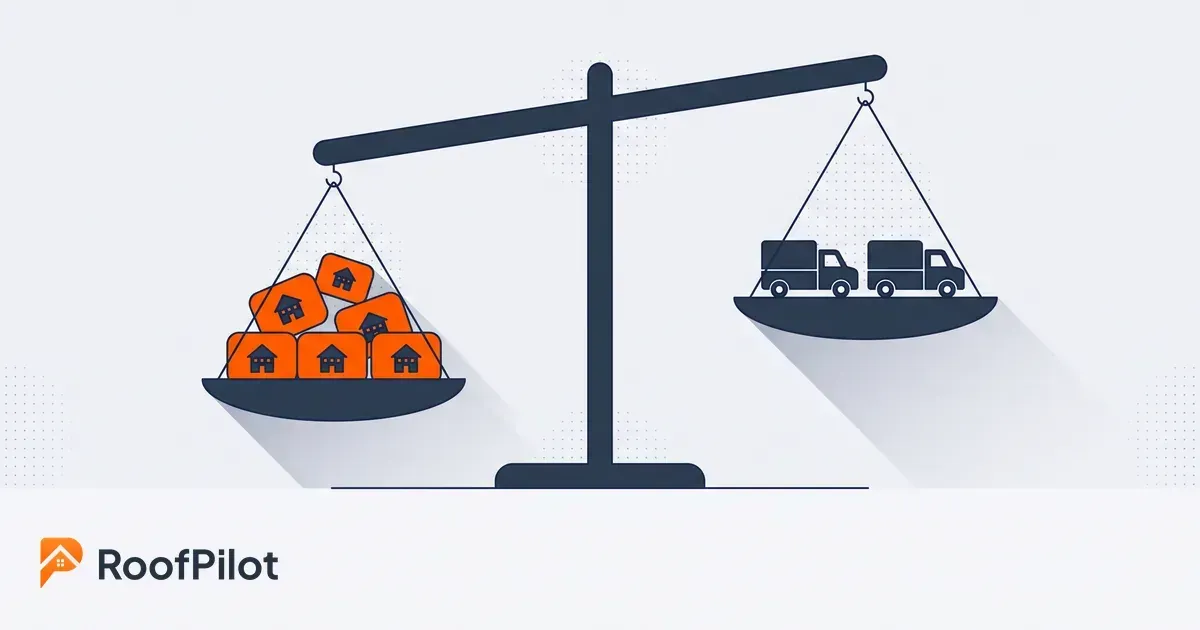
The cost argument for integrated platforms is often made by adding up individual subscriptions for standalone tools. That's worth doing: measurement service fees (often per-report), estimating software, proposal tools, and CRM each carry their own cost, and the total is usually higher than a single integrated platform subscription.


But the less visible cost is time. Per-report measurement fees are straightforward to count. The hours spent moving data between disconnected tools — re-entering measurements into an estimate template, copying estimate totals into a proposal document, manually recording customer follow-up activities — are harder to quantify but real. For a company doing 150 jobs a year, the time spent on manual data transfer between standalone tools commonly amounts to hours per week.


For smaller operations doing fewer than 30 or 40 jobs annually, a simple standalone calculator combined with manual processes may still be the right fit — the overhead of a full integrated platform may not justify the investment at that volume. But for companies running consistent volume, the efficiency argument for integration is strong, and the accuracy argument is stronger.

Making the Right Choice

Before committing to any roofing calculator app, run a real job through it — not a demo, an actual property. Enter the address, pull the measurements, build an estimate, generate a proposal, and send it. Note where the workflow is smooth and where it requires steps that feel like friction. The friction points are the ones you'll encounter on every job.


Evaluate whether the tool works the way you actually work. If your estimators are in the field on phones, a tool that works best on desktop will create workarounds. If you need same-day proposal turnaround, a process that requires returning to the office to finalize numbers won't get you there. The best roofing calculator app is the one that fits your actual workflow and that your team will use consistently — not the one with the longest feature list.


What this means for your business: Software that gets used inconsistently produces inconsistent results. The simplest tool your team will actually use on every job beats a sophisticated platform that gets bypassed when people are busy.


The Bottom Line

The shift from manual calculation to digital tools in roofing is underway, and the gap between companies that have made it and those that haven't is widening. Accurate measurements reduce material waste and protect margins. Fast estimates improve close rates. Integrated platforms eliminate the time lost to data re-entry between disconnected tools.


The right roofing calculator app doesn't need to be the most feature-rich option on the market — it needs to handle measurements accurately, build complete estimates, produce professional proposals, and fit how you actually work. For most growing roofing companies, a platform that does all of this in one integrated workflow delivers more value than any combination of standalone tools.


One platform for measurements, estimates, and proposals.

RoofPilot combines aerial roof measurement, integrated estimating, and professional proposal generation in a single workflow — no per-report fees, no manual re-entry between tools.


Roofer reviewing roofing marketing dashboard with closed jobs, revenue, and cost per lead
By Liam Walsh June 19, 2026
How to track roofing lead sources and calculate true marketing ROI — from setup to monthly review — invest in what actually closes jobs, not just generates leads.
Roofer closing more roofing jobs by presenting clear proposal on tablet to smiling homeowner
By Liam Walsh June 15, 2026
How to close more roofing jobs without adding headcount — speed, professional proposals, a repeatable sales process, and the follow-up system that converts.
Roofer receiving multiple roofing leads from Google search, Facebook ads, incoming calls, etc.
By Liam Walsh June 12, 2026
How to generate more roofing leads — proven strategies from Google Business Profile to storm marketing, referrals, and the follow-up system that closes more jobs.
Overwhelmed roofer with chaotic paperwork and sticky notes versus organized roofer using roofing CRM
By Liam Walsh June 8, 2026
How to choose the best CRM for your roofing business — essential features, what separates roofing-specific CRMs from generic tools, and red flags to avoid.
Roofer using roof waste calculator on tablet to accurately measure materials and reduce waste compar
By Liam Walsh June 1, 2026
How to reduce roofing material waste with accurate measurements, correct waste factors by roof type, and ordering practices that save thousands annually.
 roofer struggling manual calculations versus calm roofer creating instant roof estimate on a tablet
By Liam Walsh May 29, 2026
How to create instant roof estimates that win more jobs — the technology, the on-site process, and why being first with a professional quote matters.
Modern roof estimating with RoofPilot showing $12,847 total cost and easy proposal sending on a tabl
By Liam Walsh May 25, 2026
How to estimate a roofing job accurately — materials, labor, waste, overhead, and profit — plus the common mistakes that cost roofers money on every job.
Roof size calculator on a tablet showing accurate measurements including total square footage.
By Liam Walsh May 18, 2026
How to calculate roof square footage accurately — ground-based estimates, physical measurement, and automated tools.
Modern house with digital roof pitch calculator overlays showing 8/12 and 4/12 slopes
By Liam Walsh May 15, 2026
How to calculate roof pitch, read the X/12 ratio, convert to degrees, and use pitch factors to get accurate material quantities on every job.
roofing software compaison
By Liam Walsh May 13, 2026
Roofing software — one platform or multiple specialized tools? Compare real costs, integration trade-offs, and find the right fit for your business size.