May 13, 2026

Roofing Software: All-in-One Platform vs. Multiple Specialized Tools

Author

Liam Walsh

9 minute read

Share

Every roofer eventually faces the same choice: use one comprehensive platform that handles everything, or piece together a set of specialized tools — one for the CRM, one for measurements, one for proposals, and so on.


The market hasn't made this easier. A browse through any roofing software directory turns up dozens of products, each built around one part of the job cycle. The result for many roofing companies is four or five subscriptions, a tangle of integrations, and no single clear view of the business. At the same time, material cost volatility in 2026 has made accurate, real-time estimating software more critical than ever — which raises the stakes of getting this decision right.


This guide breaks down how the two approaches compare on cost, complexity, and how well each holds up as your business grows.

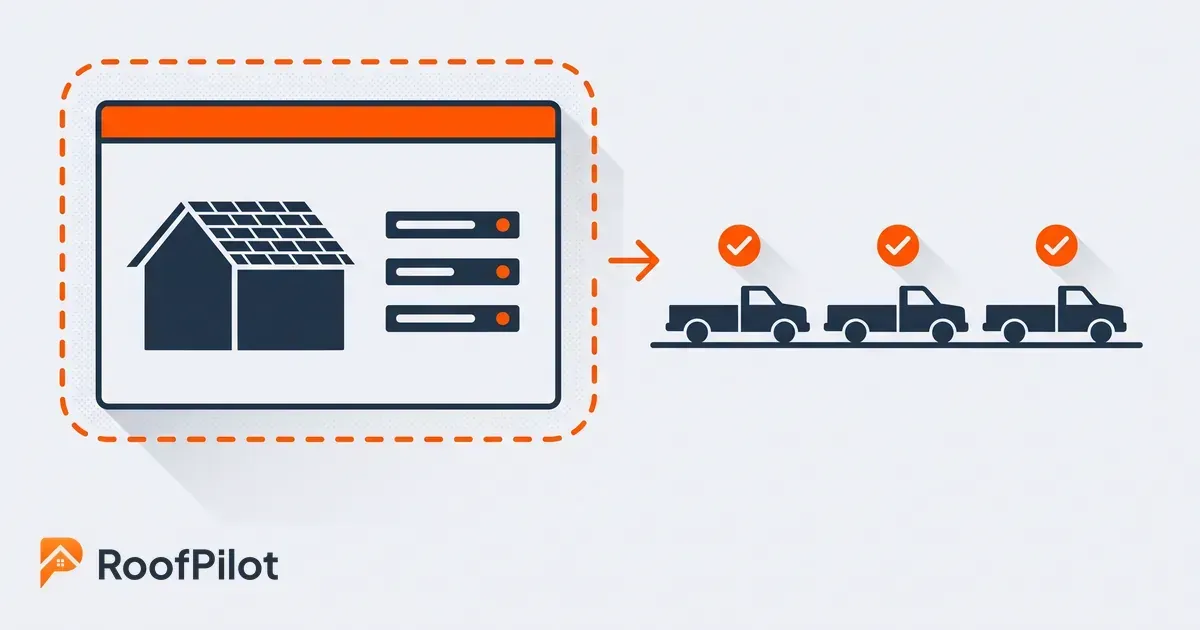
Complete roofing business workflow from client meeting to paid invoice using all-in-one roofing software instead of multiple specialized tools

What Roofing Software Needs to Do

Before comparing approaches, it helps to map out what a fully operational roofing company actually requires from its software.


At a minimum, you need tools that handle lead tracking and customer communication, roof measurements, estimating, proposal creation, job scheduling, and invoicing. More established companies add material ordering, job site photo documentation, and business performance reporting on top of that.


That's a significant list — and each item on it can be handled by a dedicated specialized tool, by a single all-in-one platform, or by some mix of both. Which approach makes sense depends on your size, your technical capacity, and how much friction you're willing to accept in day-to-day operations.

Roofer managing his business with multiple specialized roofing tools and dashboards versus a clean all-in-one roofing platform

The Multi-Tool Approach

The multi-tool approach means selecting the best specialized product for each function and connecting them together. A typical stack might include a standalone CRM, a separate aerial measurement service, dedicated proposal software, a scheduling tool, and a payments platform — each from a different vendor.


The appeal is real. Each tool is purpose-built for its function. If one product stops working for you, you can swap it without touching the rest of the stack.


The reality is messier. Tools built by different companies for different purposes don't naturally share data. Getting them to communicate usually requires integration middleware — which adds another subscription, another point of failure, and ongoing time spent troubleshooting when a software update breaks a connection. Lead data lives in the CRM. Job status lives in the scheduling tool. Photos live in the photo app. Nothing is in one place, and the owner or office manager ends up manually moving information between systems.


There's also the cost, which looks deceptive when you view each subscription in isolation. When you add them all up — including per-report fees from measurement services, integration software, and the hours spent transferring data manually — the true total almost always exceeds the sticker price.


Estimated real cost — mid-sized company doing 150 jobs per year:

Category Estimated Monthly
CRM (multi-user) $150
Measurement reports (per-report fee, avg.) $250
Proposal software $40
Job site photo documentation $30
Scheduling tool $25
Integration middleware $30
Subtotal ~$525/mo ($6,300/year)

Add time costs on top: fixing broken syncs, manually re-entering data, and training staff across multiple interfaces. A realistic fully-loaded annual cost typically runs $14,000–$16,000 or more.


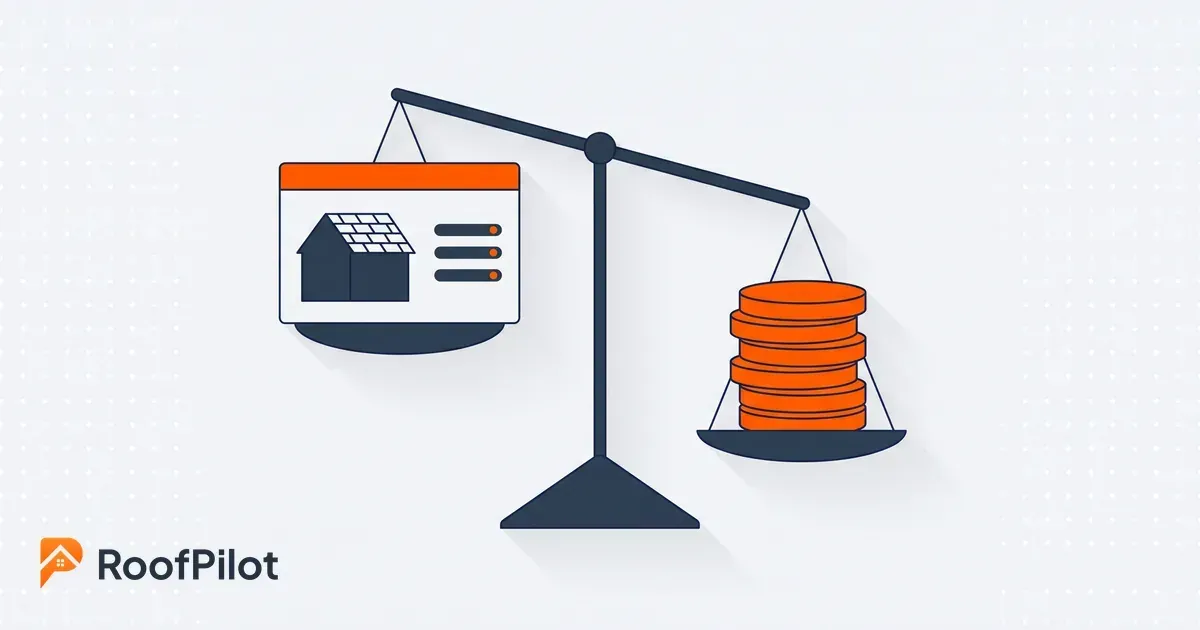
What this means for your business: The multi-tool stack feels cheaper because you're looking at individual line items, not the aggregate. Before comparing it to an all-in-one platform, add up every subscription, every per-use fee, and an honest estimate of staff hours spent keeping it running. The number is almost always higher than expected.

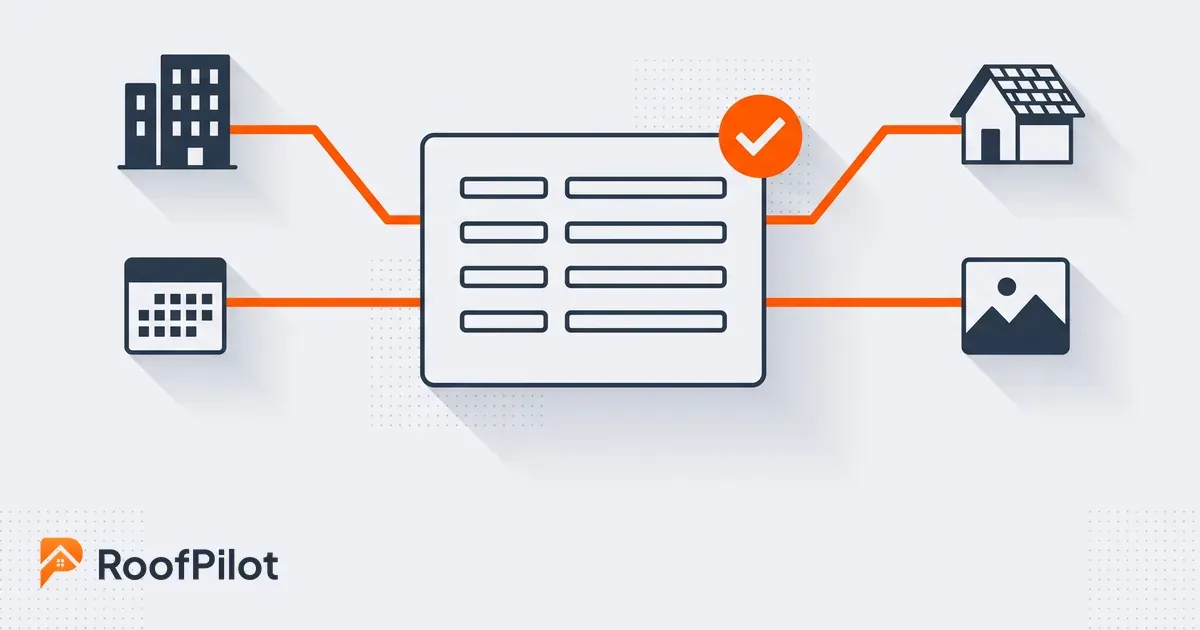
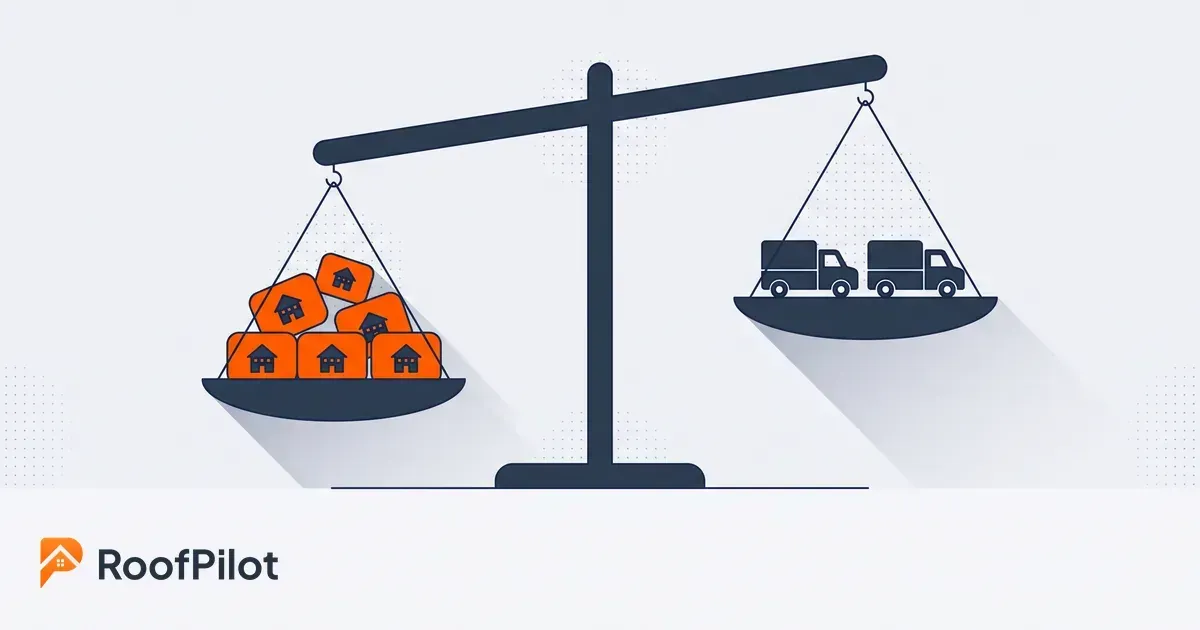
Woman using the best roofing software on an ultrawide monitor, showing a complete all-in-one roofing platform with pipeline, scheduling, and financial data

The All-in-One Approach

An all-in-one roofing platform bundles the essential functions — CRM, measurements, estimates, proposals, scheduling, invoicing, material ordering — into a single system with a single login.


The core advantage is that data flows automatically between functions. Measurements feed into estimates. Estimates turn into proposals. Signed proposals trigger scheduling. Completed jobs generate invoices. Nothing needs to be manually re-entered, and nothing gets lost between systems. With RoofPilot, every customer record shows every interaction, every estimate, every job, and every payment in one place.


The practical benefits are cumulative. Your team learns one interface instead of six. Support comes from one vendor. Reporting is actually useful because all your data is in one system. And as your business grows, one integrated platform scales significantly better than a stack of disconnected tools — a point covered in depth in the guide to scaling a roofing business.


The trade-off is reduced flexibility. You're committing to one vendor, so if a specific feature doesn't suit your workflow exactly, you can't swap it out independently. Implementation also takes more upfront effort than adding a single tool — but that's a one-time investment rather than ongoing overhead.


Estimated real cost — same company, 150 jobs per year:

Estimated Annual Cost
All-in-one platform ~$3,600–$5,500/year
Per-report measurement fees $0
Integration middleware $0
Manual data re-entry time $0
True total ~$3,600–$5,500/year

See RoofPilot pricing for current plan details.


Head-to-Head Comparison

Multi-Tool Stack All-in-One Platform
Monthly subscription cost $400–700+ $150–500
Per-report measurement fees Common None
Integration maintenance burden High None
Data re-entry between systems Frequent Eliminated
Systems to learn 5–8 1
Single source of truth No Yes
Feature depth per function High Good overall
Flexibility to swap tools High Low
Scales with business growth Poorly Well

Which Approach Fits Your Business

The multi-tool approach tends to work in specific situations: your business has requirements no all-in-one platform handles well, you already have deep workflows built around existing tools, or you have dedicated technical staff to manage integrations. Very small solo operators who only need one or two tools, and large enterprise operations with IT departments, can also make it work.


For most roofing companies in the $500K–$5M range, all-in-one is the better fit. You're large enough that disconnected tools create real operational friction, but you don't have the infrastructure to manage that friction professionally. A single platform — with integrated roofing CRM, measurements, proposals, and invoicing — is simpler to operate and consistently cheaper when you count the full cost.


If you're currently on a multi-tool stack and considering the switch, the transition is manageable. Document your current workflows before you start, clean your contact and job data before migrating, and plan for a short period running both systems in parallel. Most roofers who make the transition say the biggest surprise is discovering how much time they'd been losing to the old setup — time they didn't recognize as a real cost until it was gone.


The Bottom Line

The all-in-one vs. multi-tool question comes down to this: how much of your time and money are you willing to spend managing software instead of running your business?


For most roofers, the answer is as little as possible. A single platform that covers the full job cycle — from the first lead to the final invoice — removes the overhead that fragmented tool stacks create. For the majority of growing roofing companies, it's the more practical and cost-effective choice.


how to choose a roofing photo app
By Liam Walsh September 7, 2026
How to choose a roofing photo app your crew will actually keep using, the eight features that matter, and why integration decides whether the habit survives.
roofing marketing strategies
By Liam Walsh September 4, 2026
A grounded look at roofing marketing in 2026, the strategies winning work now, why reviews and local search still decide the year, and what is getting pricier.
estimated vs actual roofing jobs
By Liam Walsh August 31, 2026
How to reconcile estimated versus actual on every roofing job, the variance math worked step by step, where jobs go over, and how to feed it into your next bid.
roofing company outgrows spreadsheets
By Liam Walsh August 28, 2026
The signs a roofing company has outgrown spreadsheets, what a spreadsheet still does well, and how to move your jobs to a real system without losing your data.
aerial roof measurements
By Liam Walsh August 24, 2026
See how aerial and satellite roof measurements work, how accurate they really are, which free options are worth trying, and when a paid report earns its keep.
before and after roofing photos
By Liam Walsh August 21, 2026
Before and after roofing photos protect against disputes, support insurance claims, and give homeowners something to share. How to document every job the right way.
job site photos roofing
By Liam Walsh August 17, 2026
Job site photos help roofers win proposals, prevent disputes, and generate referrals. Here's how to use them strategically on every job.
recession proof roofing business
By Liam Walsh August 14, 2026
How to prepare your roofing business for an economic downturn, cash reserves, cost structure, pricing discipline, and what to do when revenue slows.
why roofing businesses fail
By Liam Walsh August 10, 2026
The most common reasons roofing businesses fail, from cash flow and underpricing to lead management and the operational blind spots that catch most roofers off guard.
roofing software training
By Liam Walsh August 7, 2026
How to get your roofing team to actually use new software. Buy-in strategies, training methods, and how to handle resistance without losing momentum.