
October 12, 2026
Roof Photos for Insurance Claims: A Documentation Workflow
Author
9 minute read
Share
Roof photos for insurance claims are the evidence a claim stands on, and on a storm job they are worth more than almost anything else you carry. When a homeowner files for wind or hail damage, the adjuster is not standing on the roof with you, so your photos become the roof as far as the claim is concerned. A complete, well-organized set gets the scope approved. A handful of blurry close-ups with no context gets the claim underpaid or denied, and you eating the difference.
This guide lays out a documentation workflow built for claims. It covers why the photos decide the outcome, what to shoot and how to shoot it so an adjuster can say yes, how to run the same reliable set on every claim, and how to keep it all organized so the evidence is there when you need it months later. Get the workflow right and you stop losing scope you actually earned.
Insurance claims live or die on your photos
On a claim, your photos are the single most important thing you produce, because they are the proof the whole approval rests on. The adjuster decides what to pay based on what they can see and verify, and if your documentation is thin, the scope shrinks to match. Roofers lose real money not because the damage was not there, but because they could not prove it well enough.
This matters more every year, because the storms that drive these claims keep coming. The U.S. set a record in 2025 with 21 billion-dollar severe storm events, part of 23 billion-dollar weather disasters that year. Every one of those storms is a wave of damaged roofs and a wave of claims, and the roofers who document well are the ones who capture the scope those claims should pay. Treating photos as an afterthought on a storm job is leaving money on the table in the one situation where the evidence is worth the most.
What this means for your business: On a claim, your camera is a revenue tool, not a formality. The gap between a well-documented roof and a poorly documented one is scope the insurer approves versus scope you argue about and often lose, so the few extra minutes on the roof pay for themselves many times over.
Photograph the whole roof, not just the damage
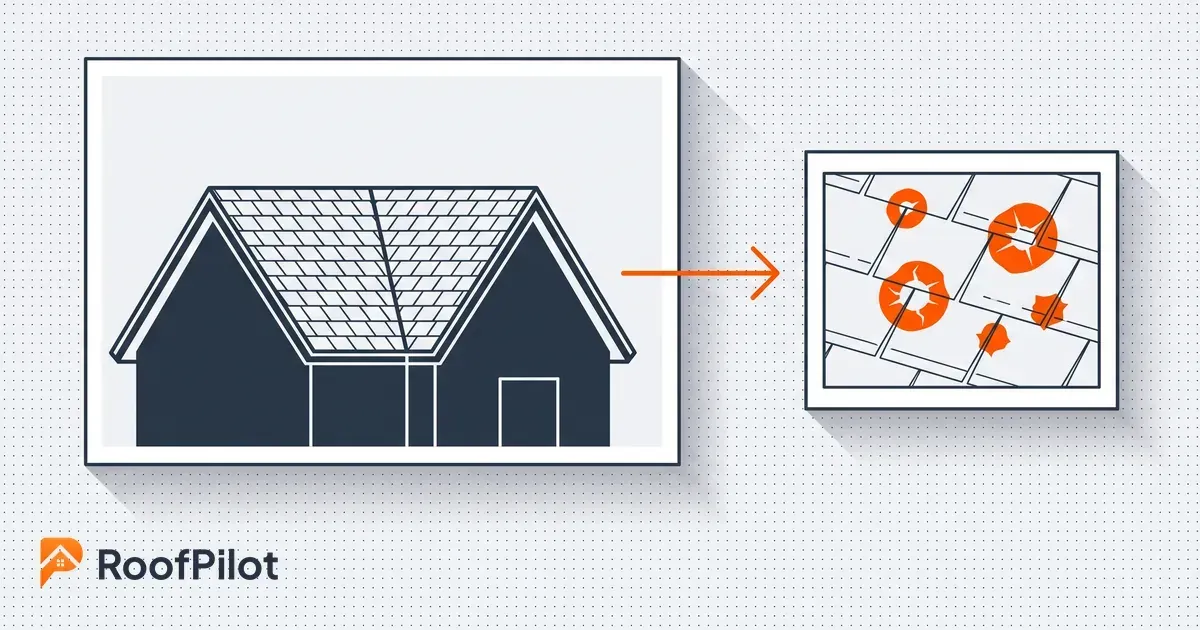
A claim needs context, so photograph the entire roof, not only the spots that are obviously damaged. An adjuster needs to understand the roof as a whole, the number of slopes, the material, the overall condition, before your damage close-ups mean anything. A pile of dents with no wider shots looks like cherry-picking, and it invites questions instead of answering them.
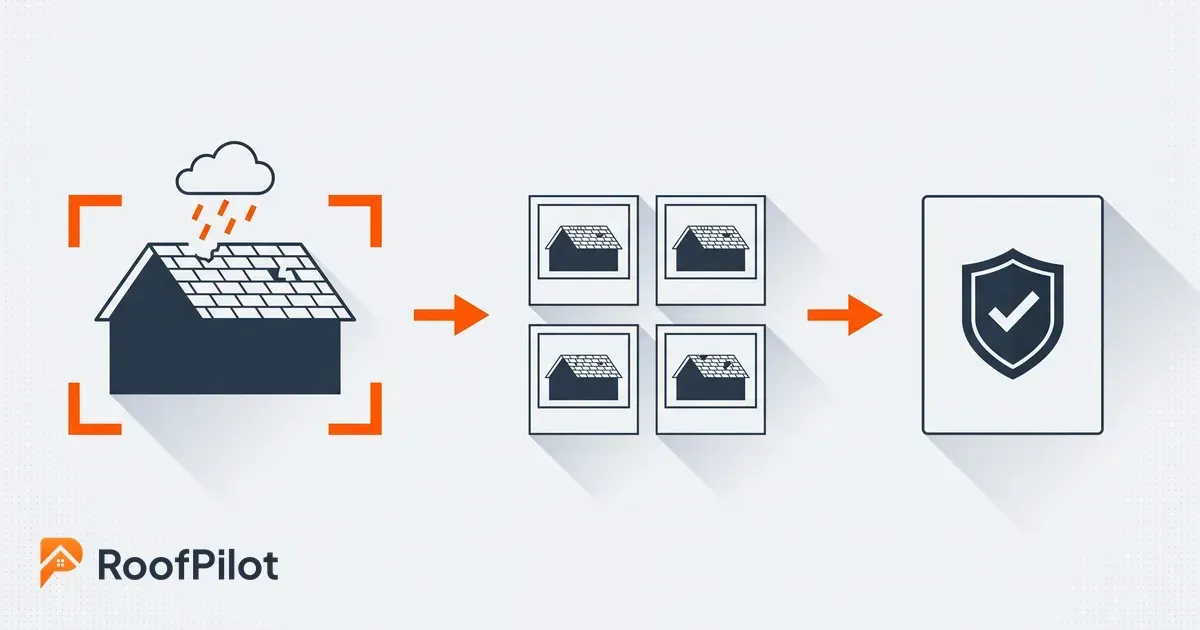
Start every roof with orientation shots: each slope from a distance, the full elevations from the ground, and the address or a landmark that ties the photos to this specific property. Then move in. The wide shots establish what the roof is and where each slope sits, and the close-ups then show the damage in a place the adjuster can locate. Context first, detail second, is the order that makes a set of photos read as a coherent story of the roof rather than a random collection of dents.
It also protects you against the most common pushback on a claim, the argument that the damage is old, pre-existing, or limited to one slope. A roof shown whole, with every slope documented, is far harder to whittle down than a handful of isolated close-ups that leave the adjuster free to assume the rest of the roof is fine.
Capture what an adjuster needs to say yes
An adjuster approves scope they can verify, so every damage photo needs to answer where it is, how big it is, and when it was taken. A close-up of hail bruising is far more persuasive with a location reference, a size reference like a chalk circle or a tape, and a reliable date on the file. Damage the adjuster cannot place or measure is damage they can discount.
Build those references into how you shoot. Mark and circle hits so they are visible in the photo, include something for scale, and capture the test squares many adjusters expect on a hail claim. Photograph the collateral evidence too, the dented gutters, the soft metal on vents and flashings, the spatter on the AC unit, because that surrounding damage corroborates the story on the roof. And make sure every file carries an accurate date and, ideally, a location, since a photo an adjuster cannot trust the timing of is a photo that does not help you. The goal is that each image answers a question before the adjuster has to ask it.
Shoot the same reliable set on every claim
Consistency is what keeps a claim from falling apart over a shot you forgot, so use the same photo checklist on every storm job. When documentation depends on whoever climbed the roof remembering what matters, some claims come back complete and others are missing the one angle that would have settled it. A standard shot list makes the quality of your evidence independent of who is holding the phone.
Write the list down and work it every time: elevations and slope overviews, the damage close-ups with location and scale, the test squares, the collateral damage, and the supporting details like the data plate or existing layers. A rep new to storm work should be able to follow the same sequence a veteran does and come back with a set an adjuster can approve. This is the same discipline that makes the same photos that help you win the work valuable on the sales side, applied to the higher stakes of a claim, where a missing photo has a dollar figure attached.
Keep the photos organized with the claim
Photos you cannot find are photos you did not take, so every image needs to live with its job and its claim. Storm season means dozens of roofs in a short stretch, and a camera roll with hundreds of unlabeled photos from twenty addresses is worse than useless when an adjuster asks for the north slope on a specific house. The organizing is as important as the shooting.
Keep each roof's photos attached to that job from the moment they are captured, not sorted out later from a phone that has moved on to the next address. When you file every claim photo with its job automatically, the set is already assembled and dated when it is time to submit, and you are not rebuilding a claim from memory. Running it in RoofPilot, where the photos, the job, and the customer are one record, means the evidence for a claim is always where the claim is, even weeks later when the adjuster comes back with a question.
Document before, during, and after
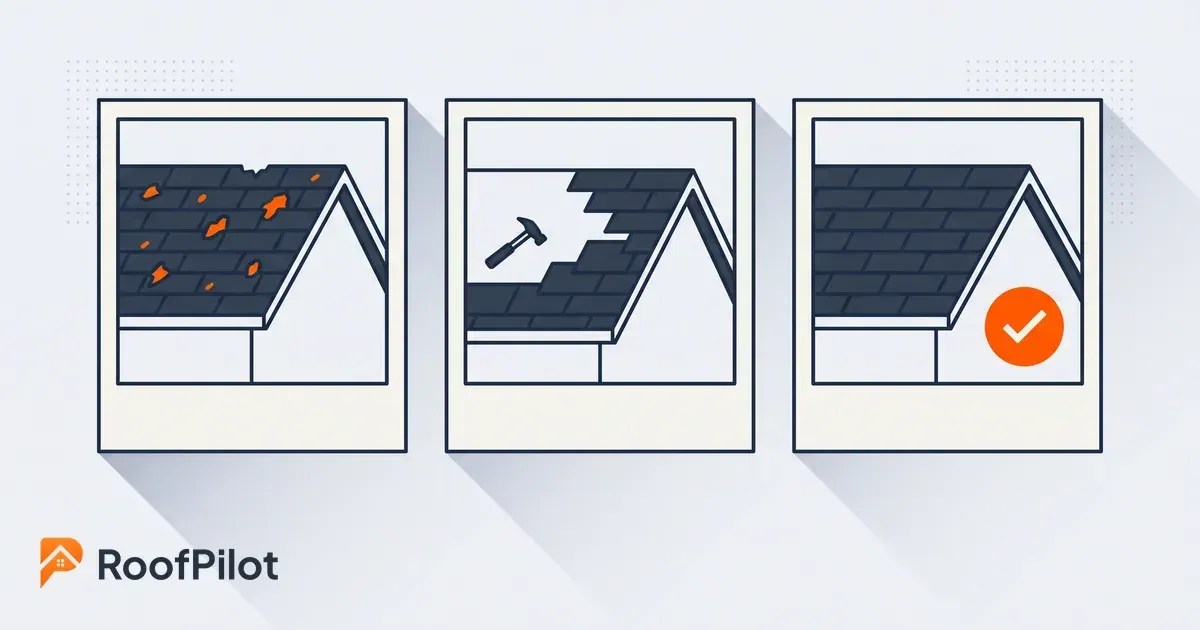
A claim is stronger when you can show the roof through the whole job, so document the condition before you start, the relevant conditions during, and the finished result. Before-photos establish exactly what the storm did and what you are being paid to replace. After-photos prove the work was completed to scope, which protects your final payment and closes the loop with both the homeowner and the insurer.
That full arc protects you long after the check clears. If a payment is questioned, if the homeowner misremembers what was replaced, or if a dispute surfaces months later, the record answers it. This is the same reason before-and-after photos that settle disputes are worth capturing on every job, not just claims: the roof you can show is the roof nobody can argue about. On an insurance job, that arc of evidence is what turns a claim into a paid, closed, dispute-proof file.
What this means for your business: Treat the before-and-after set as part of the claim, not a marketing nicety. It is what protects your final payment and shuts down disputes, and on a storm job it costs you nothing but the discipline to shoot the roof at the start and the finish.
The Bottom Line
On an insurance claim, your roof photos are the case, and how you document decides how much scope gets approved. Shoot the whole roof for context before the damage close-ups, and make every damage photo answer where it is, how big it is, and when it was taken. Run the same shot list on every claim so the evidence never depends on who climbed the roof, and keep every photo filed with its job so the set is ready when you submit and still there if a question comes back. Document the roof before, during, and after to protect your payment and close out disputes. Do that consistently and you stop losing scope you earned, which on a storm roof is the difference between a profitable claim and an argument.
Related reading: