

September 18, 2026
Pipeline Hygiene for Roofing Sales Teams
Author
9 minute read
Share
Pipeline hygiene is the unglamorous habit that separates roofing sales teams who hit their numbers from the ones who are always surprised by them. It is the ongoing discipline of keeping every deal in your sales pipeline accurate, current, and honestly staged, so the pipeline tells you the truth instead of a story you want to hear. Most roofers do not lose deals because their pipeline is empty. They lose them because their pipeline is a mess.
This guide is a practical walk through that discipline. It covers what pipeline hygiene actually is, why a messy pipeline quietly costs you money, what a clean roofing pipeline looks like, the stages it should have, how to keep the marketing-to-sales handoff clean, the rules that keep it from rotting, and how often to clean it. None of it takes special software to understand, though it gets a lot easier when your deals live in one place.
What is pipeline hygiene?
Pipeline hygiene is the practice of keeping your sales pipeline accurate and up to date, so every opportunity in it reflects a real deal at a real stage. It means stale deals get closed out, active deals carry a clear next step, and nothing sits in a stage it left weeks ago.
Think of it the way you think of a job site. A clean site is not the goal for its own sake, it is what lets the crew move fast without tripping over yesterday's mess. A clean pipeline does the same thing for your sales team, because a pipeline you trust is one you can actually run the business on.
Why does a messy pipeline cost you money?
A messy pipeline costs you money because it lies to you, and you make decisions on the lie. When dead deals sit open and live deals are mis-staged, your forecast is fiction, and a fiction is a dangerous thing to schedule crews and order materials against.
The damage shows up in three places. Your forecast inflates, because deals that will never close are still counted, so you plan for revenue that is not coming. Your capacity planning goes wrong, because you cannot tell how much real work is about to land. And your team wastes time, chasing deals that died months ago while genuinely hot leads cool off unnoticed in the same list. A pipeline nobody trusts is a pipeline nobody uses, and then you are back to running sales out of memory and sticky notes.
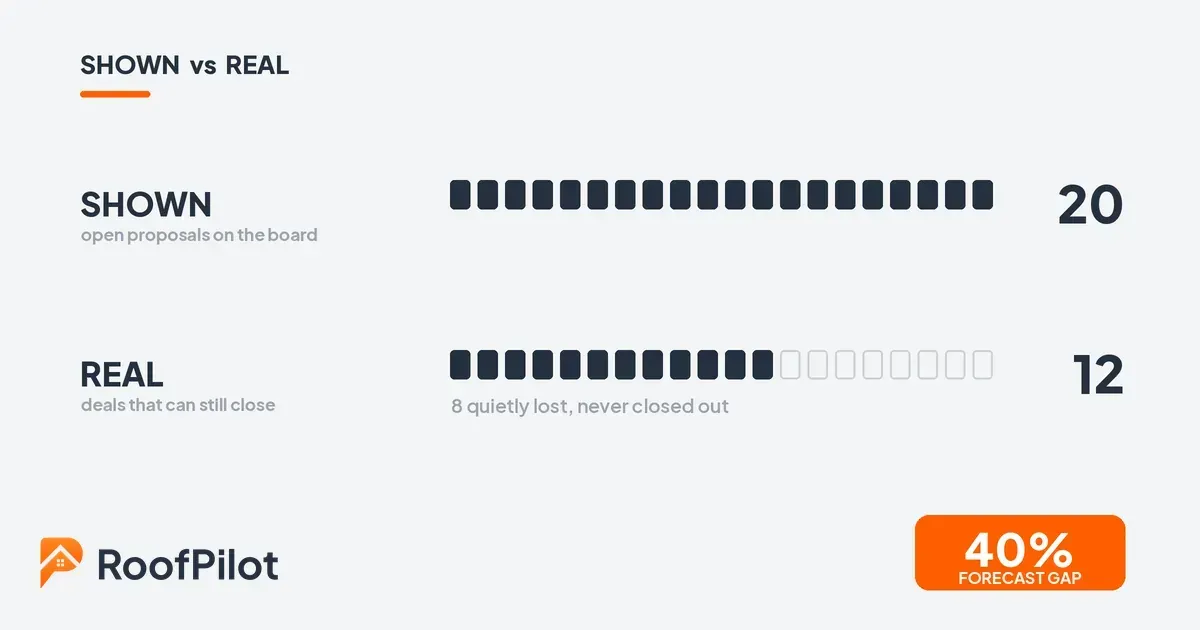
Picture a pipeline showing twenty open proposals. If eight of them were quietly lost weeks ago and never closed out, you are scheduling crews and ordering materials against a number that is off by forty percent, and you will feel that gap as either a crew standing around with no work or a job you promised and cannot cover. The pipeline did not lie on purpose. It just told you what nobody bothered to correct.
What this means for your business: If you cannot look at your pipeline right now and believe the number at the bottom, that is the problem to fix first. Every downstream decision, from hiring to material orders, is only as good as the pipeline it is based on.
What does a clean roofing pipeline look like?
A clean roofing pipeline is one where every open deal has four things: a clear stage, an owner, a next action with a date, and an honest estimate of whether it will close. If any deal is missing one of those, it is not really being managed, it is just being stored.
The test is simple. You should be able to scan the pipeline and, for every deal, answer who owns it, what happens next, and when. Deals that fail that test are the ones that slip through the cracks, the signed job nobody scheduled, the estimate nobody followed up on, the inspection that was never booked. Clean means every card in the pipeline is a decision waiting to happen, not a mystery waiting to be forgotten.
What stages should a roofing sales pipeline have?
A roofing sales pipeline should have a short, clear set of stages that mirror how a job actually moves, from new lead to won or lost. The exact names matter less than the rule that every stage has a defined entry and exit, so a deal only advances when something real has happened.
A simple, reliable structure runs something like new lead, contacted, inspection scheduled, inspection complete and estimate prepared, proposal sent, then won or lost. The discipline is not the labels, it is refusing to let a deal live in a stage it has outgrown. A proposal that was sent three weeks ago with no response is not still in "proposal sent" in any useful sense, it is either a follow-up you owe or a loss you have not admitted. Keep the stages few, keep the exit criteria clear, and keep your whole team using the same ones, because a pipeline where everyone stages deals differently is not a pipeline, it is several private guesses. The opposite failure is just as common as too few stages: a pipeline carved into a dozen micro-stages nobody keeps current, which is exactly where deals hide. A handful of stages your team actually maintains beats a detailed map that goes stale by Tuesday.
How do you keep the marketing-to-sales handoff clean?
You keep the handoff clean by making sure every lead marketing generates lands in the pipeline with its source and context attached, and gets worked fast. The handoff is where the most leads leak out, because a lead that arrives with no owner and no clock on it is a lead that quietly dies.
Speed is the part roofers underrate. Harvard Business Review research on online sales leads found that most companies do not respond to new leads nearly fast enough, and in roofing a homeowner whose lead sits overnight is a homeowner a faster roofer already called back. So the handoff needs two things: every marketing lead drops into the same pipeline automatically, tagged with where it came from, and every new lead gets a fast, owned first response instead of landing in a shared inbox nobody owns. Once it is in, the deal needs a real follow-up rhythm, which our guide to building a follow-up sequence that converts lays out.
What this means for your business: Put a clock on new leads. Decide the longest a fresh lead can go without a first response, make one person accountable for hitting it, and measure it. Speed to first contact is the single cheapest pipeline improvement most roofing teams have available.
What rules keep a pipeline clean?
A pipeline stays clean when a few simple rules are non-negotiable, and the two that matter most are: every open deal has a next step with a date, and every dead deal gets closed out honestly. Those two habits alone prevent most of the rot.
The supporting rules are just as concrete. No deal sits with no activity past a set number of days without being reviewed. Close-lost is a real outcome you record with a reason, not a deal you leave open forever because admitting the loss feels bad. There is one source of truth for the pipeline, not a CRM plus a personal spreadsheet plus a whiteboard. And a deal only moves forward on evidence, never on optimism. Write these down, hold the team to them, and the pipeline stops needing a heroic cleanup because it never gets that dirty in the first place. This is far easier to enforce when there is one pipeline your whole team can actually see rather than scattered lists, and choosing which CRM fits your roofing business is its own decision worth getting right.
How often should you clean your pipeline?
You should clean your pipeline in a short weekly review, not in an occasional heroic purge when it has become unusable. A standing weekly pass keeps the mess small enough to clear in minutes instead of letting it build into a project nobody wants to start.
The weekly review is a simple ritual. Walk the pipeline stage by stage, update or advance every deal, close out the dead ones, and confirm each survivor has a next step and a date. It works best as a fixed appointment, the same time every week, treated as seriously as a production meeting, because it is the thing that keeps every other number honest. Run it in RoofPilot alongside the rest of your jobs and the review becomes a fast scan of one live board rather than a reconciliation of competing lists. A pipeline reviewed every week is a pipeline you can trust every day.
The Bottom Line
Pipeline hygiene is not busywork, it is the discipline that makes your forecast, your scheduling, and your sales effort trustworthy. Keep every open deal at an honest stage with an owner, a next step, and a date. Close dead deals out instead of letting them inflate the number. Guard the marketing-to-sales handoff with speed and clear ownership, hold the line on a few simple rules, and clean the pipeline in a short weekly review instead of a yearly panic. Do that and your pipeline stops being a list you avoid and becomes the clearest picture you have of where the business is actually headed.
Related reading: