August 17, 2026
How Roofers Use Job Site Photos to Win More Work
Author
9 minute read
Share
Every roofer has a camera in their pocket. Most use it to take photos that end up in a camera roll they'll never search through again, disconnected from job records, impossible to find when a customer calls with a question six months later, and certainly never organized into anything a homeowner would find impressive.
In 2026, the roofers winning more work at better margins aren't just better at roofing, they're better at documentation. A before-and-after photo report sent to a homeowner at job completion generates reviews at a rate that a bare invoice never will. A set of timestamped before photos ends a pre-existing damage dispute in minutes. A proposal that includes photos of the homeowner's actual roof, with problem areas labeled, closes faster than a one-page price sheet. The photos are the same work you're already doing. What changes is whether they're captured systematically and used strategically. RoofPilot is built so that job site photo documentation lives inside the same platform as your jobs, proposals, and customer records, not in a separate app that nobody consistently uses.
This guide covers the four moments on every job that produce the most valuable photos, how to use them to win proposals and prevent disputes, and how to build a system your crew will actually follow.
Why Photos Are a Business Tool, Not an Afterthought
A roof replacement is largely invisible to the homeowner once it's done. They can't see what was removed, what was found underneath, or whether the installation was done correctly. They have to take your word for it, and most of them know they're taking your word for it.
That's both a challenge and an opportunity. Roofers who document their work with photos give homeowners something they rarely get from any trade: evidence. Evidence of the condition before you arrived. Evidence of what was found. Evidence of the quality of what was installed. That evidence builds trust during the sale, eliminates disputes after the job, and gives satisfied customers something concrete to share when they refer you to a neighbor.
The roofers who use photos most effectively don't think of documentation as a compliance task. They think of it as a sales and protection tool that pays off at multiple points in the customer relationship. The framework for building that approach into your broader sales process is covered in the guide to close more roofing jobs.
The Four Moments That Produce the Most Valuable Photos
Not all job site photos are equally useful. The ones that move the needle for your business fall into four distinct moments, and skipping any of them leaves money, or protection, on the table.
Before work starts is the most important set of photos you will ever take on a job, and the most commonly skipped. Before any shingle is touched, document the existing condition of every section, every problem area, every piece of flashing, every valley, and every penetration. When a homeowner calls three months after the job and says the flashing was damaged before you arrived, before photos end the conversation immediately. When an insurance adjuster questions pre-existing damage, you have documentation. Comprehensive before photos protect you before the job even begins, and the few minutes they take are worth far more than the hours a dispute costs.
During the job , progress photos serve two audiences. For your office, they let you see what's happening on a job site without requiring a supervisor to be physically present, if something looks wrong in a mid-job photo, you can address it before the crew moves on. For the homeowner, a quick update sent at midday showing tear-off progress or underlayment going down dramatically reduces "is anyone working on my house?" calls and begins building the kind of trust that turns into a review.
When something unexpected is found is the moment that determines whether a change order becomes a smooth conversation or an uncomfortable dispute. Every experienced roofer has opened up a roof and found rotted decking, improper previous flashing, or hidden storm damage that the estimate didn't account for. Roofers who photograph the problem before they address it, and share those photos with the homeowner before proceeding, almost never have change order disputes. Roofers who fix the problem and then try to explain it with words often do. Stop, photograph the issue, share it with the homeowner, get approval, then proceed. A few photos taken in the right moment protect thousands of dollars in change order revenue.
After completion , a final photo set serves as your portfolio, your proof of work, and your insurance simultaneously. Shoot every side of the finished roof, the ridge detail, flashing and penetration work, valleys, and the gutter line. These photos close out the job record, support any warranty claims that arise, and give you the raw material for reviews, referrals, and marketing.
How Photos Win Proposals Before the Homeowner Signs
Most roofers think of photos as documentation that happens after the sale. The ones winning consistently at higher margins use photos during the sale.
When meeting with a homeowner, take photos of the problem areas on their roof and show them on the spot. Use a tool that lets you annotate, circle the cracked flashing, mark the damaged area, highlight the granule loss. The homeowner goes from trusting your word to seeing the problem with their own eyes. A homeowner who can see exactly what's wrong with their roof closes faster and with less price resistance than one who has to take a stranger's word for it.
A proposal that includes photos of the actual roof, labeled, organized, and professional, looks completely different from a competitor's one-page price sheet. When a homeowner is comparing two proposals that evening, the one that shows photos of their specific roof, annotated and connected to specific line items, stands out from anything without that detail. Roofing proposals that include job-site photo context make the case for your price rather than just stating it.
What this means for your business: The gap between a proposal with photos of the homeowner's actual roof and a proposal without them isn't subtle, it's the difference between a document that feels like it was made for this specific homeowner and one that feels like it was generated from a template. Homeowners feel that difference even when they can't articulate it.
How Photos Reduce Disputes
Roofing disputes are expensive, in time, stress, and sometimes real money. The most common ones center on two questions: what condition was the roof in before you started, and was the work done correctly? Documentation answers both, and the absence of documentation makes both much harder to resolve in your favor.
The Insurance Information Institute advises homeowners to photograph or videotape damage when filing a property insurance claim, because that visual record helps document the loss and assists the adjuster. The same principle applies when a homeowner claims pre-existing damage was caused by your crew, or when a change order is disputed after the fact.
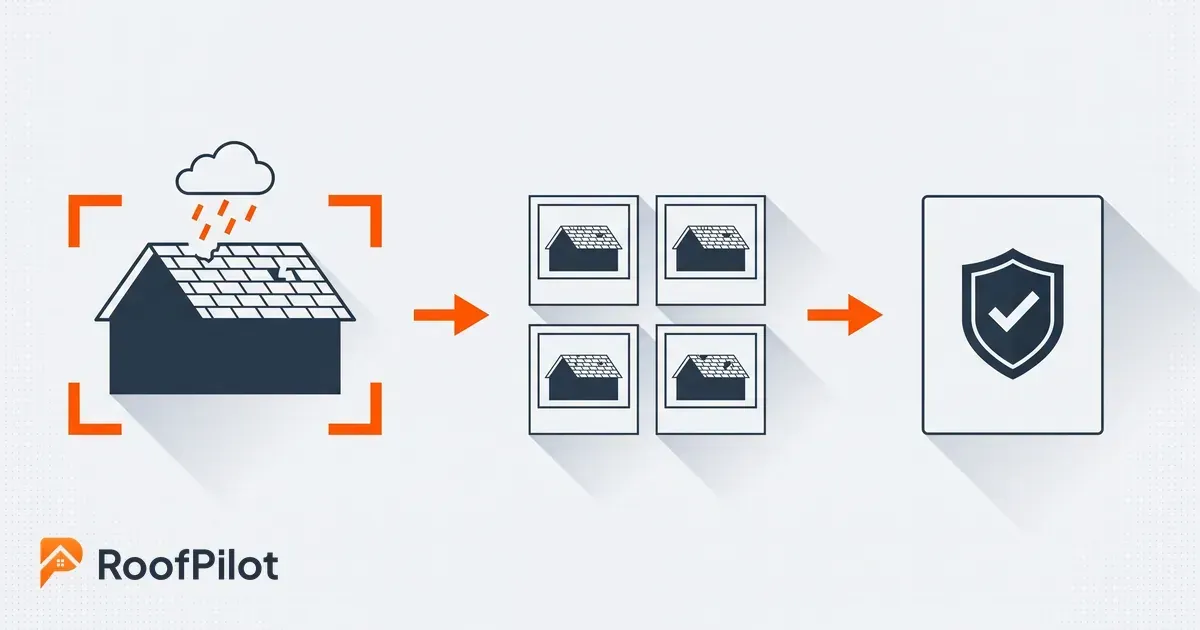
A before photo that shows cracked flashing before the job started ends a pre-existing damage conversation immediately. A completion photo taken right after the job, timestamped and in the job record, addresses workmanship questions with a factual record rather than a competing version of events. A mid-job photo of the problem you discovered before addressing it, combined with the documented conversation where the homeowner approved the change, makes the change order dispute a non-issue. The cost of one avoided dispute typically exceeds the cost of a full season of proper documentation.
Turning Photos Into Reviews and Referrals
Satisfied customers are the best marketing in roofing, but most of them don't leave reviews, not because they're unhappy, but because the moment passes and nothing prompts them. A before-and-after photo report sent at job completion changes that.
When you send a homeowner a report showing the condition their roof was in before you arrived and what it looks like now, you give them something to share. Something to show their neighbor who's been putting off their own roof. Something to post. Something to reference when they tell a friend about the roofing company they used. The report is the prompt that converts a satisfied customer into an active referral source.
The follow-up sequence that produces the most reviews is simple: send the completed job photo report immediately at project close, then follow up two days later with a note thanking them and asking directly for a Google review with the link included. Roofers who run this sequence consistently generate reviews at a meaningfully higher rate than those who send only an invoice.
What this means for your business: Every completed job is a potential review, a potential referral, and a potential portfolio piece. The photo is the raw material for all three. Without a systematic way to capture and use it, the opportunity expires when the crew pulls away from the job site.
Building a Photo System That Actually Gets Used
Knowing what to capture is one thing. Building a system that produces consistent documentation on every job, with every crew, is another. The roofers with the best photo documentation aren't necessarily the most disciplined, they have the lowest-friction tools.
When photos are captured in a separate app and have to be emailed or uploaded to attach to a job record, the extra steps get skipped when the crew is busy or the job is running behind. When photo capture is built into the same platform your crew uses for everything else, job details, schedule, work orders, it happens because the workflow demands it rather than requiring extra effort.
The practical standard a photo system needs to meet: photos captured on-site and automatically attached to the job record, accessible to the office in real time without anyone transferring files, available to pull into proposals without switching apps, and shareable with the homeowner in one step. That's the difference between documentation that happens consistently and documentation that depends on whether each crew member remembered to do it that day.
Related reading: