
September 11, 2026

What to Include in a Roofing Quote (With a Template)

Author

Liam Walsh

9 minute read

Share

roofing quote software

Knowing what to include in a roofing quote is most of the job of writing one. A homeowner is rarely choosing between roofs. They are choosing between roofers, and the quote is the first real evidence of how you run your business. One that spells out the scope, the materials, the timeline, and the price tells them you will show up when you said and not surprise them with a bigger number later. A single figure with no detail behind it tells them the opposite, and it is also how you end up absorbing work you never agreed to.

This covers the difference between a quote and an estimate, the seven blocks every roofing quote needs, a template you can copy and adapt, how to price it so the number holds, and what to expect roofing quote software to handle so nothing gets left out by hand.

Quote or estimate, and why the difference matters

roofing quote vs estimate

Roofers use the two words interchangeably. Homeowners do not, and the gap is where disputes start.

An estimate is your best informed guess before you have every detail, and it is understood to move. A quote is a firm price for a defined scope, and it is the number the customer believes they will actually pay. When you write "quote" at the top of a document, you are making a commitment.

That means the discipline of a good quote is really the discipline of defining scope tightly enough that you can stand behind the price. Most roofing arguments that begin with "but you told me" are scope problems wearing a pricing costume. The answer is not to hedge every line. It is to be specific about what the price covers and, just as importantly, what it does not.

If you are still working out the number itself rather than how to present it, start with the estimating math behind the number and come back to this.

What every roofing quote should include

There is a baseline here that is not a matter of taste, because it is what homeowners are told to expect. The Federal Trade Commission's consumer guidance on home improvement work says plainly that a written estimate should include a description of the work to be done, materials, completion date, and the price. A quote that contains all four reads as legitimate before the customer has evaluated a single number. One that is missing two of them raises a question you then have to answer.

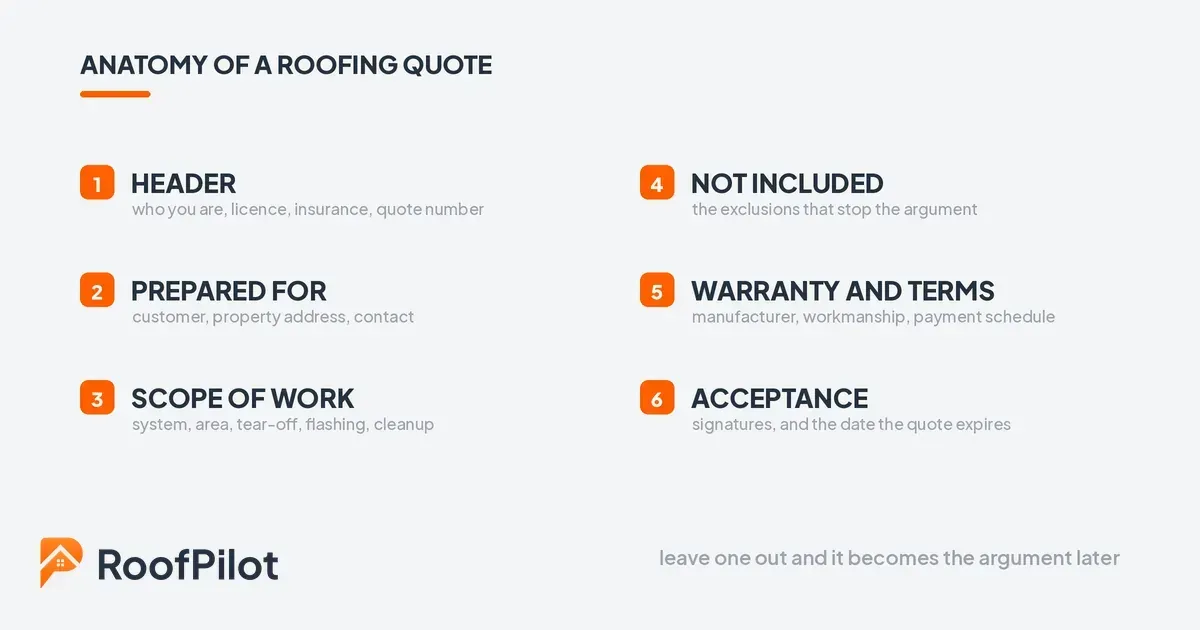
Build on that baseline with seven blocks:

One, your business details. Company name, license number, insurance, phone, email. This is credibility on line one and it is also what a cautious homeowner checks first.

Two, the customer and the property. Name, contact, and the property address, listed separately from the billing address when they differ.

Three, the scope of work. The block that decides everything. System and product, area, layers coming off, decking inspection and replacement allowance, underlayment, ice and water placement, ventilation, flashings, penetrations, and edge metal. Write it so a homeowner reading three quotes can tell yours apart.

Four, exclusions. What is not included, stated plainly. Unforeseen decking replacement beyond the allowance, structural repairs, gutters, interior repairs. Naming these is not defensive, it is the difference between an honest quote and a low one.

Five, materials. Manufacturer, product line, colour, and warranty. Homeowners comparing quotes are often comparing materials without realising it.

Six, price and terms. The number, what it covers, the payment schedule, and how change orders are handled. Say how variations get priced and approved before there are any.

Seven, validity and next step. How long the price holds and exactly what happens when they accept.

What this means for your business: The exclusions block is the one most roofers leave out and the one that pays for itself fastest. Every ambiguity in a quote becomes either an uncomfortable conversation on the roof or free work you absorb, and the exclusions are where you decide which.

The template

roofing quote template

Copy this and adapt it. Everything in brackets gets replaced with your information.

[COMPANY NAME] [Street Address] · [City, State ZIP] [Phone] · [Email] License #: [Number] · Insured: [Carrier]

ROOFING QUOTE

Quote # Q-2026-0184
Date [Date]
Valid Until [Date, typically 30 days out]
Prepared By [Name]

PREPARED FOR

Customer [Name]
Property Address [Street, City, State ZIP]
Billing Address [If different]
Phone / Email [Contact]

SCOPE OF WORK

Item Detail
Roof system [Manufacturer, product line, colour]
Area [Squares, and which sections or elevations]
Tear-off [Number of layers to be removed, or overlay]
Decking [Inspect all; replace damaged sheathing up to [X] sheets, included]
Underlayment [Product and coverage]
Ice and water shield [Eaves, valleys, penetrations as applicable]
Ventilation [Ridge vent, intake, changes from existing]
Flashing [Step, counter, chimney, wall, valley]
Penetrations [Pipe boots, skylights, satellite mount]
Edge metal [Drip edge product and colour]
Cleanup [Debris hauled, magnet sweep of drive and lawn]
Permits [Included / by owner]

NOT INCLUDED

  • [Decking replacement beyond the allowance above, priced per sheet on approval]
  • [Structural or framing repairs]
  • [Gutters, downspouts, fascia, soffit unless listed above]
  • [Interior repairs or paint]

MATERIALS AND WARRANTY

Manufacturer warranty [Product, term, and registration]
Workmanship warranty [Your term and what it covers]

PRICE AND TERMS

Total [Total price]
Payment schedule [Deposit on acceptance, balance on completion]
Change orders [Priced and approved in writing before the work is performed]
Estimated start [Window]
Estimated duration [Days]

ACCEPTANCE

Customer signature ______________________ Date: __________
[Company] representative ______________________ Date: __________

The validity date matters more than it looks. Material costs move, and a quote with no expiry is one you may be held to months later on numbers that no longer work.

How to price it so the number holds

A quote is only as good as the number in it, and the number is only safe if it covers what the job will actually cost you.

Price from measured quantities, not from a look at the roof. Then build up: materials with waste, labour at your real burdened rate, disposal, permits, and your overhead and margin as a deliberate figure rather than whatever is left over. A quote that wins the job and loses money is not a win, and it is the most common way a growing roofing company gets into trouble.

Handle the unknowns with allowances instead of optimism. Decking is the classic: inspect, include a stated number of sheets, and price additional sheets per unit on approval. That turns the single biggest source of roofing change orders into a line the customer already agreed to.

Speed matters as much as accuracy, because a homeowner comparing three roofers usually decides before the slowest one has replied. If you can send an instant estimate the same day you are competing on a different footing, and that is worth setting up properly.

What roofing quote software should do for you

roofing quote automation

Most quote problems are omissions rather than mistakes. Nobody writes the wrong underlayment, they leave the field blank and the crew guesses. That is a systems problem, and it is what roofing quote software is actually for.

Judge a tool on five things. Does it produce a quote from your measurements without retyping them. Does it enforce a template so the scope, exclusions, and warranty blocks cannot be skipped. Can the customer read and accept it on a phone. Does the accepted quote become the work order the crew builds from, unchanged. And does it keep every version, so you know what the customer actually agreed to.

That last one is where a lot of disputes are quietly won. If your quote lives in a document that has been edited four times, you have no record of which version was accepted. A system that versions the quote and timestamps the acceptance ends that argument before it starts.

The practical payoff is consolidation. When the same record carries the measurement, the quote, the acceptance, the work order, and the invoice, nothing is re-entered and nothing drifts. Running it on RoofPilot is that version, and when a quote is accepted you turn an accepted quote into a signed proposal without rebuilding the document.

Mistakes that cost you the job

A short list, in rough order of how often it happens.

One line and a number. It looks like you did not do the work. Detail is the cheapest credibility available.

No exclusions. You will discover the missing boundary at the worst possible moment.

No validity date. You are exposed to material movement indefinitely.

Silence on change orders. Then every variation becomes a negotiation on the roof.

Slow delivery. The best quote in the market loses to an adequate one that arrived four days earlier.

Undercutting to win. A price that beats everyone usually means you missed something, and the customer will find out at the same time you do.

No follow-up. A quote sent is not a quote considered. Someone has to close the loop.

Before you send it

☐  All four FTC baseline items present: description of work, materials, completion date, price

☐  Scope specific enough that a homeowner can tell your quote from a competitor's

☐  Exclusions written down, not assumed

☐  Decking or other unknowns covered by a stated allowance with a per-unit rate

☐  Manufacturer and workmanship warranties both stated

☐  Payment schedule and change-order process spelled out

☐  Validity date on the quote

☐  Your licence and insurance details on the first block

☐  A clear next step for accepting

What this means for your business: Run a pre-send check until it becomes automatic. Almost every quote failure is a blank field rather than a wrong one, and a check that takes under a minute catches nearly all of them.

The Bottom Line

A roofing quote is a commitment to a price for a defined scope, which makes scope definition the whole job. Start from the baseline homeowners are told to expect, a description of the work, the materials, a completion date, and the price, then add your business details, the property, exclusions, warranties, terms, and a validity date. Price from measured quantities with deliberate margin, and handle unknowns like decking with stated allowances rather than hope. Judge quote software on whether it stops fields being left blank, carries the accepted quote through to the work order without retyping, and keeps a version history you can point at. Then send it quickly, because the fastest credible quote usually wins. Once it is accepted, the contract that follows an accepted quote and an invoice template built the same way close out the same job with the same discipline.

Related reading:


By Liam Walsh • October 26, 2026
How to run the ROI numbers on roofing software. Add up the hours saved, the rework you stop paying for, and the jobs you win, then weigh it against the cost.
By Liam Walsh • October 23, 2026
How to run a software pilot in your roofing company before you commit. Pick one crew and real jobs, set what to measure, and see if a new tool actually fits.
By Liam Walsh • October 19, 2026
A roofing mobile app puts the whole business in your pocket. Run jobs, photos, quotes, and invoices from your phone so the office and the roof stay in sync.
By Liam Walsh • October 16, 2026
Keep your roofing office and field data in sync. One source of truth across your CRM, calendar, and field tools so nobody rekeys or works off stale information.
By Liam Walsh • October 12, 2026
A roof photo workflow built for insurance claims. How to capture, organize, and time-stamp storm damage photos so an adjuster approves them the first time.
By Liam Walsh • October 9, 2026
Your roofing production backlog is the work you have sold but not yet built. How to size a healthy backlog, keep jobs from aging, and protect the cash in it.
By Liam Walsh • October 5, 2026
What to put in a roof inspection report, a ready-to-use template you can copy, and how to turn your findings and photos into a report that wins you the job.
roofing capacity planning
By Liam Walsh • October 2, 2026
Capacity planning for roofing crews is knowing how much work you can actually take. How to size your real capacity, set a buffer, and match crews to demand.
roofing dispatch
By Liam Walsh • September 28, 2026
Roofing dispatch is getting the right crew to the right job on the right day. How to run day-of dispatch, cut idle crew hours, and keep every job on track.
sales to production handoff
By Liam Walsh • September 25, 2026
The sales-to-production handoff is where roofing jobs get dropped after the sale. How to hand off a signed job complete, set a handoff SLA, and stop the leaks.